WhatsApp Cloud API: what's free, what you still have to build, and how to decide
Meta's Cloud API costs nothing to use, which makes "just connect to it directly" a reasonable-sounding instinct. This guide separates what Meta actually hands you from what you are still on the hook for — so the decision is made on scope, not on the word "free".
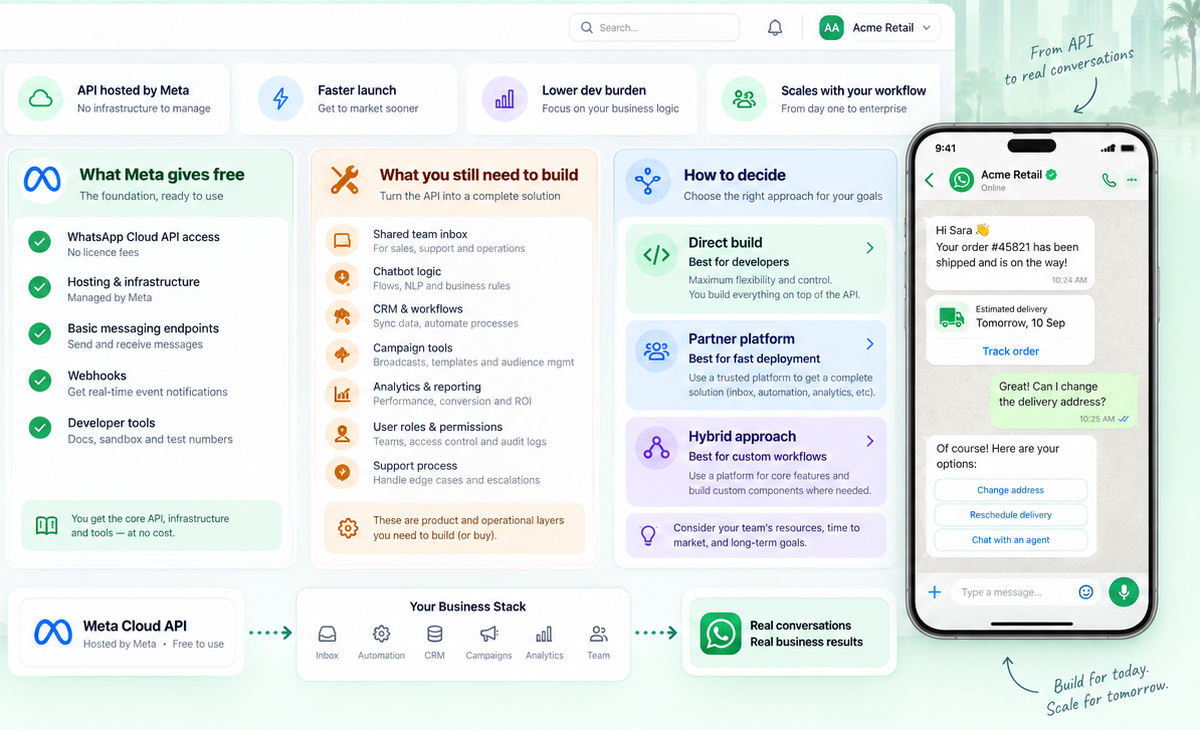
The WhatsApp Cloud API is free — Meta charges no licence or hosting fee. It gives you endpoints to send messages, manage templates and receive webhooks. It does not give you an inbox, agent seats, contact records, routing, campaign tools, automation, analytics or any interface at all: inbound messages arrive at a URL you have to build and host. Meta's per-conversation charges apply either way, direct or through a platform. So the real question is not "free vs paid" — it is whether you want to build and maintain the layer that sits on top.
- Cloud API access: free from Meta. Per-conversation charges: not free, and unavoidable
- No user interface ships with the Cloud API — it is endpoints and webhooks only
- A developer is required; without a webhook server you cannot receive a single reply
- Meta has retired the On-Premises API — Cloud API is the official path
- Numbers can move between direct setup and a platform without changing the number
- At Go4whatsup, Meta's charges pass through at cost as a separate line — never marked up
What the Cloud API actually is
The Cloud API is Meta's hosted interface to WhatsApp. You send an HTTP request, Meta delivers a message. Someone replies, Meta posts that reply to a webhook URL you operate.
That is the whole product. There is no screen, no login for your team, no place a reply "appears". If nobody has built something to receive that webhook, the customer's message is delivered into nothing.
This is the part that surprises people. "Free API" sounds like a free product. It is closer to free plumbing: genuinely valuable, genuinely free, and useless until someone builds the building around it.
What "free" covers, and what it doesn't
| Meta gives you, free | You provide, either by building or buying |
|---|---|
| Send-message endpoints | A webhook server, hosted and monitored |
| Template submission and status | A shared inbox your team can actually work in |
| Inbound message webhooks | Conversation history and contact records |
| Delivery and read receipts | Agent assignment, routing, queues, SLA tracking |
| Media upload and download | Campaign sending, segmentation, scheduling |
| Phone number and WABA management | Automation, chatbots, AI replies, translation |
| Quality rating and tier signals | Reporting anyone outside engineering can read |
Both columns are real work. The left column is Meta's, done and free. The right column is yours — and it does not end at launch, because tokens rotate, webhooks fail, Meta ships breaking changes, and someone has to be responsible for that at 2am.
The one cost that is identical either way. Meta charges per conversation, not per message, and those charges land whether you integrated yourself or pay a platform. Nobody can make Meta's fees disappear. Anyone implying otherwise is either absorbing them into a higher subscription or is not on the official API. Go4whatsup passes them through at cost as a separate line item, never marked up — see Meta's WhatsApp pricing explained.
A note on "Cloud API vs On-Premises"
Most comparison articles still frame this as Cloud API versus the On-Premises API. That was the live question around 2022, when businesses hosted WhatsApp's Docker containers themselves.
Meta has retired the On-Premises API. Cloud API is the official path now. If you are reading a comparison built around on-prem hosting, it is answering a question that no longer exists. The 2026 decision is direct versus platform.
Who should go direct
Going direct is the right call more often than platform vendors admit. Choose it when:
- Messages are one-way and machine-generated. OTPs, delivery pings, payment confirmations. Nobody needs to read replies, so no inbox is needed.
- You already own the interface. If your agents live in a support desk or an internal admin tool you built, adding WhatsApp as another channel there is sensible.
- You have engineering capacity to keep, not just to launch. The build is the small part. Owning it for three years is the commitment.
In all three, you are not avoiding the work — you are choosing to do it because it fits something you already have.
Who should use a platform
Choose a platform when humans are in the conversation. The moment a customer expects a person to reply, you need everything in that right-hand column — and you need it before the first campaign, not after.
Concretely, a platform is what gives you a shared inbox with routing, campaigns and segmentation, no-code automation, and the AI layer: replies drafted from your FAQ, campaign copy generated, and auto-translate across 100+ languages with AI replies in 30+.
That last one is hard to appreciate until you need it. A self-built Cloud API integration can send Arabic perfectly well. It cannot let an English-speaking agent hold an Arabic conversation.
And the option most people land on
The choice is rarely all-or-nothing. A common shape: run the customer-facing conversations on a platform, where agents, routing and translation already exist, and keep your own service calling the API directly for the machine traffic — OTPs, receipts, delivery pings. You get the inbox without rebuilding it, and your engineers keep direct control of the automated volume. Both paths use the same number and the same WABA.
What the layer on top actually produces
Two Go4whatsup customers. Numbers from their published case studies, not projections.
MOJ Water · Kuwait
3×
Revenue, with orders processed 5× faster and missed deliveries down 40%. A 24/7 bilingual Arabic + English bot handles ordering with no agent involved — that bot is the layer, not the API.
SkillLab Academy · Ed-tech
3.4×
Lead-to-enrol rate versus the email control group, measured on a 2,800-lead A/B test. Demo attendance went from 29% to 62% on reminder flows at T-24h and T-1h.
How to decide in five minutes
- Will a human ever need to read a reply? If no, direct is likely fine. If yes, you need an inbox — build or buy.
- Do you have a developer who will still be here in a year? Not to build it — to maintain it.
- How many people need access? One system sending notifications is different from nine agents sharing a number.
- What languages do your customers write in? If more than one and your team does not cover them, translation is not optional.
- Try the platform side free before you estimate the build. Our free plan needs no credit card. Comparing a real inbox against your own spec takes an afternoon and prevents a six-month detour.
Quick answers
Where to go next
- How to get WhatsApp Business API access — the setup path end to end
- Migrating a WhatsApp Business number — moving without losing it
- Meta's WhatsApp pricing explained — what the conversation charges actually are
- Official vs unofficial WhatsApp API — a different question, worth knowing
- How to choose a provider — once you have decided on a platform
- Go4whatsup on the WhatsApp Business API · AI WhatsApp tools compared
Compare the build against the real thing
Already on the Cloud API? Bring your number across. Starting fresh? The free plan needs no credit card, so you can put a working inbox next to your own spec before committing engineering time.
Start free Book a demo