
In manufacturing, delays rarely start on the shop floor — they start with poor communication.
Sales teams commit delivery dates without real production visibility.
Production teams get interrupted constantly for status updates.
Dispatch teams receive last-minute “where is the truck?” calls.
Finance teams chase invoices that customers “didn’t see.”
Every department ends up reacting instead of working.
Most manufacturers don’t suffer from bad systems — they suffer from too many follow-ups, calls, and unclear updates.
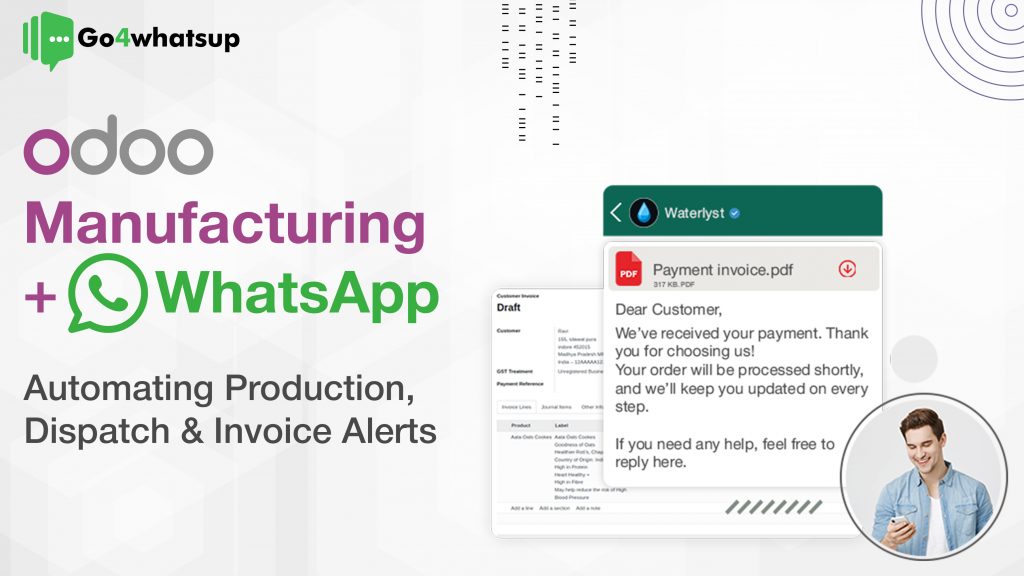
This is where Odoo Manufacturing + WhatsApp automation becomes practical. Not as a marketing tool, but as a way to keep everyone informed automatically, without slowing down operations.
This guide explains how integrating Odoo Manufacturing with WhatsApp helps manufacturers reduce daily chaos, improve visibility, and keep production, dispatch, and invoicing aligned.
The Real Communication Problem in Manufacturing
From sales order to final delivery, a manufacturing order passes through multiple teams:
- Sales
- Production planning
- Factory floor
- Quality control
- Dispatch & logistics
- Finance
When communication depends on emails, calls, or manual updates, problems appear quickly:
- Sales keeps asking production for updates
- Production teams lose focus due to constant interruptions
- Customers call repeatedly asking for dispatch status
- Finance follows up on invoices that are already sent but unnoticed
The root issue is simple:
People don’t have real-time visibility.
By connecting Odoo workflows with WhatsApp alerts, manufacturers replace uncertainty with clarity.
How Odoo WhatsApp Automation Fixes Manufacturing Follow-Ups
WhatsApp automation works by sending automatic updates based on actions already happening inside Odoo.
No extra data entry.
No separate tools.
No manual messaging.
Whenever something important happens in Odoo — production starts, goods are ready, shipment is dispatched, invoice is generated — a WhatsApp message is sent to the right person.
1. Automated Production Updates That Reduce Internal Pressure
Production teams are constantly interrupted with one question:
“What’s the status of this order?”
With Odoo Manufacturing + WhatsApp automation, production updates are shared automatically.
How it works:
- Order Confirmed
When a sales order creates a manufacturing order, a WhatsApp update is sent to the customer and internal sales team:
“Your order #[SO-Number] has been confirmed and scheduled for production.” - Production Started
When the MO status changes to In Progress:
“Production for your order has started and is on schedule.” - Quality Check Stage
When items move to quality control:
“Your order is undergoing final quality checks.”
Result:
- Fewer calls to production
- Sales teams stay informed
- Customers trust timelines
- Production teams work without interruptions
2. Dispatch Alerts That Eliminate “Where Is My Order?” Calls
The dispatch stage is where anxiety peaks — both for customers and internal teams.
Without clear updates:
- Customers keep calling
- Sales escalates issues
- Logistics teams waste time answering the same questions
With WhatsApp dispatch automation:
- Ready for Dispatch
“Your order is packed and ready for dispatch.” - Shipment Confirmed
“Your order has been shipped. Track it here: [Tracking Link]”
These messages are triggered directly from Odoo Inventory and Delivery actions.
Result:
- Customers track orders themselves
- Fewer inbound calls
- Dispatch teams stay focused on execution
3. Invoice Alerts That Improve Cash Flow Visibility
In manufacturing, delayed payments don’t just affect finance — they affect production planning and raw material procurement.
Email invoices often:
- Go unread
- Get buried
- Are forwarded late
With WhatsApp invoice automation:
- Instant Invoice Delivery
“Your order has been dispatched. Invoice attached. Due date: [Date].” - Automated Payment Reminders
Gentle reminders are sent before and after the due date without manual follow-ups.
Result:
- Invoices are seen faster
- Fewer payment chase calls
- Better working capital control
A Realistic Manufacturing Workflow Example
Company: Precision Parts Inc. (B2B manufacturer)
- Order Confirmed
Sales confirms order in Odoo.
WhatsApp update sent to client and sales head. - Production Begins
MO starts on the factory floor.
Automated WhatsApp update confirms progress. - Dispatch Ready
Goods are packed and validated in Odoo.
Client receives dispatch alert. - Shipment & Invoice
Tracking link and invoice are sent via WhatsApp automatically.
Throughout the process:
- No one asks for updates
- No department chases another
- The customer stays informed without calling
Why This Matters for Manufacturers Today
Manufacturing businesses scale when:
- Communication becomes predictable
- Teams stop reacting
- Customers trust timelines
WhatsApp automation adds a real-time communication layer on top of Odoo Manufacturing that:
- Reduces daily follow-ups
- Prevents internal blame
- Improves customer confidence
- Speeds up invoicing cycles
Frequently Asked Questions
Can dispatch tracking links be sent automatically?
Yes. Once a delivery is validated in Odoo and a tracking number exists, WhatsApp messages can include clickable tracking links.
Does this reduce interruptions on the shop floor?
Yes. When sales and customers receive automatic updates, production teams are not disturbed for status checks.
Is WhatsApp suitable for B2B manufacturing?
Absolutely. With the official WhatsApp Business API, communication remains professional, secure, and scalable.
Can different teams receive different alerts?
Yes. Sales, production heads, logistics, finance, and customers can receive role-specific alerts.
What do I need to implement this?
Odoo Manufacturing, Sales, Inventory modules, a WhatsApp Business API account, and an Odoo-WhatsApp connector.
Final Thoughts
Manufacturing success depends on precision, predictability, and control — not constant follow-ups.
Odoo Manufacturing + WhatsApp automation doesn’t change how you produce.
It changes how smoothly information flows.
By automating production updates, dispatch alerts, and invoice notifications, manufacturers can:
- Reduce daily chaos
- Protect production focus
- Improve customer trust
- Strengthen cash flow visibility
For manufacturers tired of endless calls and unclear updates, this is a practical step toward calmer, more efficient operations.